Submitted by reuben on Sun, 08/21/2022 - 15:29

I swore I was going to be good and write in this travel blog diary far more than I have, but here it is, going into the final week of my stay at the Samadhi Yoga Ashram, and I have only put up one entry so far.

Needless to say, they are keeping us quite busy as part of the daily routine. Then when it comes to our valuable free time, we have spent much of it bonding with the others in the ashram. I also made a new random friend last weekend when a South American traveler asked me for a recommendation on a place to eat.

But more on that later.

Kundalini Awakening

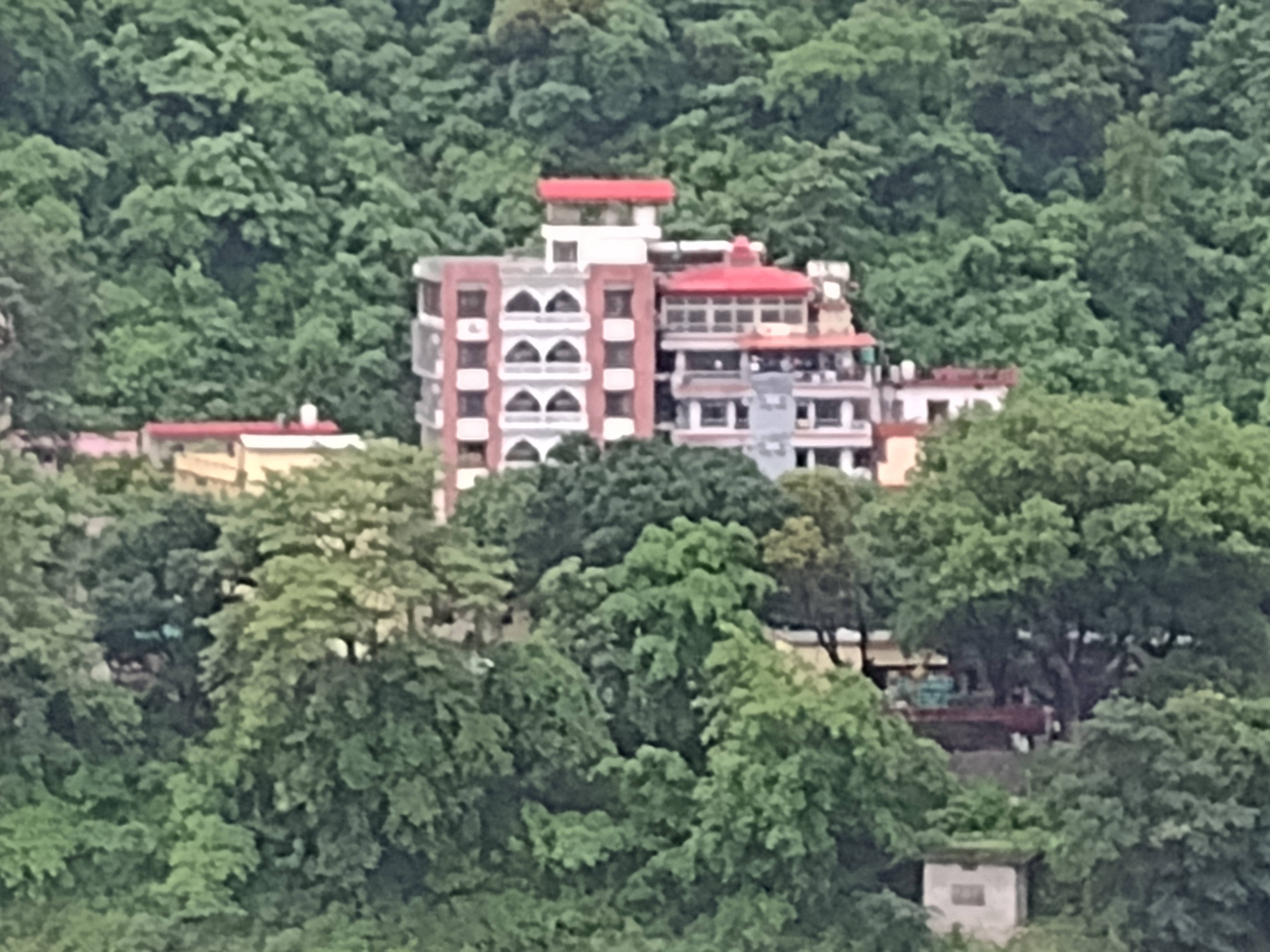
Samadhi Yoga Ashram across the riverFor those of you who are not aware, the program I am enrolled in at the Ashram is actually a specific form of yoga called Kundalini. If you are not new to yoga, or even if you just have a passing interested in certain esoteric knowledge, you may well have encountered the term chakras at some point.

Kundalini yoga (pronounced koon-DAH-lee-nee YOG) is the scientific study of these energetic centers of our bodies and practical techniques to activate or awaken the dormant energies that travel throughout the body through rivers of lifeforce called nadis.

Having been introduced to chakras during my first yoga classes in college in the 1990s, I thought I knew a fair amount about what these energy bodies were all about. What I throught I knew was just surface level, however, and even after a month of more intensive study, I still feel like I am only starting to scratch the surface.

What I can say though, is that I am really starting to feel these energy centers within my own body, particularly along the spine. Earlier today, I went to see a physiotherapist – basically an ayurvedic chiropractor – and I could literally feel my manipura chakra – or solar plexus – burning with yellow hot energy.

We are learning techniques to energize the nadi system, cleanse the chakras (which are actually the major junctions of the more than 72,000 nadis) and then gradually activate and awaken them. Once the chakras are awakened, the central channel of the spinal energy called the sushumna is ready for the rising of the Kundalini energy, visualized by a snake coiled in the mooladhara, or root chakra.

The problem with my western mind is that I want to get this Kundalini awakening along with the certifacte the ashram will hand me for completing their accredited 200 hours teacher training course. Needless to say, it is not that simple. It takes an advanced practitioner of Kundalini yoga months to master each technique and move along to the next one. Then maybe after a few years of practicing these techniques at least a few hours every day, the Kundalini energy might rise and begin the process of awakening the higher self. And it is a process that could take many lifetimes to master. And while I have no real idea where I am at in this journey over my past lives, I am pretty sure I am not at the beginning either.

Ayurvedic Healing

Before coming here, I had almost no idea what was meant by Ayurveda. I knew that ayur is health in Sanskrit and and the Vedas are the supreme source of knowledge. My yoga teacher Teresa also introduced me to the concept of the doshas and suggested that I was most likely a vata dosha.

The ayurvedashalaWell Teresa, if you are reading this, a well-trained ayurvedic doctor has confirmed your suspicion about me. I am, in fact, very vata, with a bit of fiery pitta dosha, which helps explain my red hair and blue eyes.

This general diagnosis also explains a lot more about my character than I could have ever imagined. Like why I am on this journey to begin with; why I have weird vivid dreams but can rarley remember them; why my belly has been so upset for the majority of the time I have been here.

In addition to going to see this doctor, our anatomy class is actually an ayurvedic health class. As part of a 200-hour YTT course, I assumed anatomy would be largely about the muscles and joints that we are working when practicing asanas, but this introduction to this centuries-old holistic medicinal philosophy has been so much more rewarding than a western style physiology course.

In addition to the doctor’s diagnosis of my dosha, he recommended that I get at least three ayurvedic massages and three shirodhara treatments to help lubricate my joints.

The skeptic in me thinks maybe he is just selling his shala’s therapeutic services, but at a rate of about $15 per hour for massage, I thought a few rounds definitely would not hurt. Needless to say, the massage was amazing and shirodhara, which involves applying a constant stream of oil to the forehead was an oddly rejuvenating experience.

And then there was the ayurvedic physiotherapist today. Dr. Pushpa Badwal, who was born in the last Indian village before the Tibetan border, where I plan to visit upon leaving Rishikesh, does amazing work. As I mentioned previously, I could feel my chakras vibrating as she did the therapy.

When I left, my knees, which have been worsening for the past couple of years felt better than they have in a long time. I want to get back and see Dr. Pushpa at least one more time before I leave.

Fellow classmate Sondrine said she wants to see if she can fit the doctor in her luggage and take her back to Paris. I joked that that sounded a little like human trafficking.

Regardless, the whole introduction to Ayurveda has been just as eye-opening and rewarding as the Kundalini experience and it is quite amazing the way all the pieces fit together to make a seamless whole.
Bhakti Celebrations

Another term I was only vaguely familiar with was Bhakti or devotional yoga. I had dome some back in my college days, chanting and dancing at the Krishna House south of the Ohio State University campus and some kirtan at the retreat I attended last year in Costa Rica.

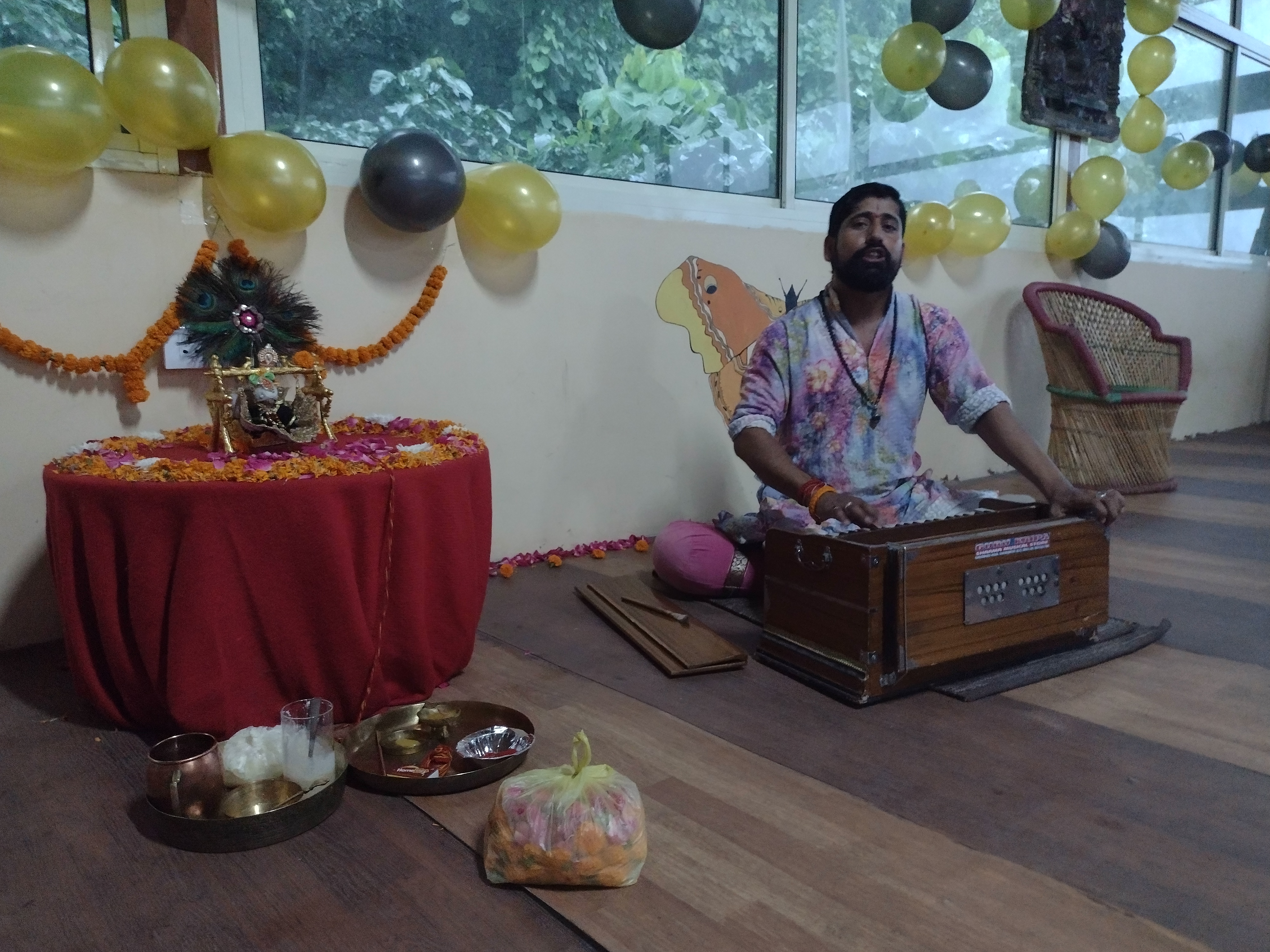
Well we have daily philosophy and chanting classes with Mandeep Ji, a jovial man of close to my age maybe, who really seems to love his job. I’m not sure if he is a full-flledged “guru” or not, but he definitely has the potential to be one when the right student(s) present themselves.Mandeep Ji leadng the Krishna birthday celebration

Mandeep Ji has been responsible for explaining the heavy philosophical terms passed down through the Vedas and the ancient sages – much of the same material we learned in our college philsophy courses at a mor in-depth and firsthand perspective.

But he also puts on one heck of a show.

We have celebrated several religious holidays, sister-brother day, a few birthdays and even the national Independence Day just in the first three weeks of this month.

Take this past Friday night. Despite, the fact that a monsoon rainstorm was well underway that day, Mandeep Ji showed up on his motorcycleto lead a special celebration to celebrate Krishna’s “birthday.” It is amazing the way he and other priests here can memroize and recite this endless litany of devotional chants, play the harmonium or other instruments and get an entire crowd fired up to join in this passion they have for this higher power.

I’ve really never witnessed anything quite like it, other than possibly the closing kirtan we had at Brave Earth, led by Sam Garrett and Mollie Mendoza with accompaniment by Mose. But even that seemed somewhat more constructed than this ability to just jump right into this chant and just do it.

Anyhow, this is just another amazing part of what I have been learning that I don’t think I would have experienced at a standard YTT class.

Hatha Yoga

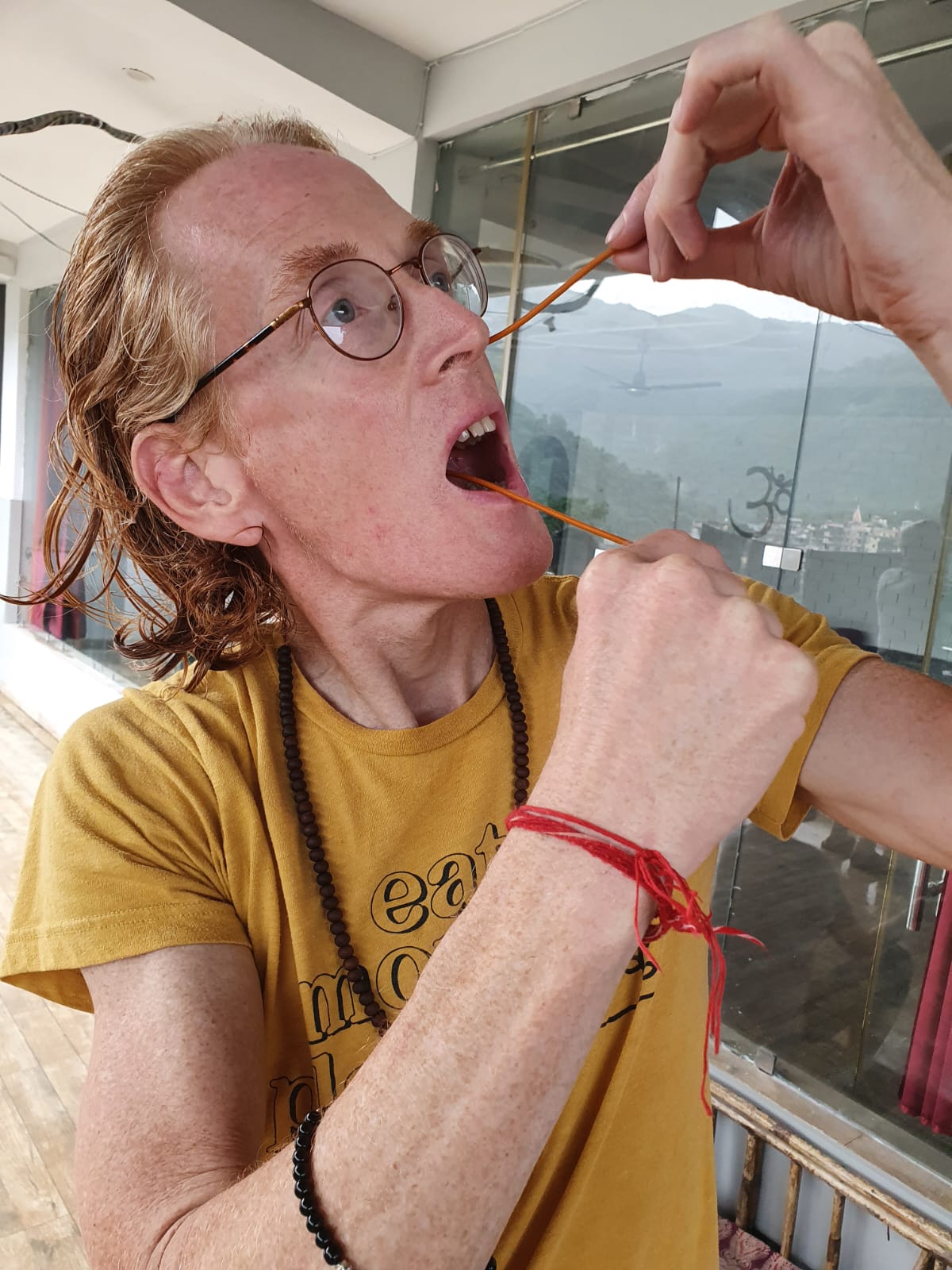
Going into this experience, I can honestly say I had no idea what Hatha yoga (HOT-ta YOG) was. I used to think it was just the slow style of yoga where the instructor would focus on one pose at a time – as opposed to Vinyasa, which is a style that involves linking poses together in a flowing sequence.Doing the Sutra Neti

That notion has been entirely dispelled.

Hatha yoga actually derives from the Sanskrit words hakar and thakar, which are the sun and moon energies – Shiva and Shakti, the pingala and ida nadis, positive and negative, the yang and yin as the Chinese describe them. It is much more akin to Kundalini than I ever imagined.

But there is also this very interesting aspect of it called the shatkarmas that we aren’t just learning about but practicing as well. These cleansing techniques are very odd indeed – things like pouring water up your nostrils, flossing your tonsils with a catheter tube and an intestinal cleaning followed by a special diet called Kechari.

But there is the asana part of Hatha yoga and it is somewhat like the idea I had in my mind about the slow approach to yoga – the really slow approach ... that is. I think I mentioned Ashu Ji and his agonizing ... 9 ... ... 9 ... ... and ... ... 10 counts. He has lightened up on that a bit, but classes in the upper story of the ashram, amid the humid monsoon weather, are quite literally a hot yoga class without the added heat.

Sun salutations, or Surya Namaskar, in Hatha yoga are not the same as we practice at most of the studios I have frequented in Ohio. It is a very structured 24-part series and each part is performed with focus on a particular chakra.

We had our teaching practice in this style just yesterday. I designed a class around teaching Chakrasana or wheel pose. Ashu Ji gave me positive feedback on my submission so I think it went well.

Yogic Aspirations

Don’t get me wrong, I have no preconceived notions that when I get that laminated sheet of paper next weekend that I will be a fully qualified yoga teacher. I have much respect for the many people who do teach yoga for a living and the many individual teachers who have helped shape me into the yogi that I am becoming.

I may be able to design and hopefully manage a yoga class at this point, but I have a great respect for those who have spent years of their lives already dedicated to this craft. I don’t really feel it is my calling to teach, and despite the harm it does to my spine, I kind of miss the challenges of my networking job.

I do hope to share some of the knowledge that I am gaining on this journey and as I begin to develop my own personal practice more deeply. I am sure I will find a shala wherever I land to call home.

So, as I look back on this blog, it seems I kind of diverged from the point I was going to write about and ended up on this reflection on what we have been learning and practicing in the school. I hope you enjoy it, as I am running out of time to write for the night. I think I have said enough for the the time being.

I hope to update you all in the near future on my plans to head north into the mountains on the India Tibetan border – the mystical home of the great sage Babaji.