Submitted by reuben on Thu, 09/22/2022 - 12:58

Last week, I had what could be a once in a lifetime opportunity to listen to the teachings of the 14th Dalai Lama and have been trying to get my head around his message ever since.

As a note, His Holiness delivered the teachings in his native Tibetan and this was translated by an English translator and broadcast over an FM radio frequency. I listened on a small pocket radio and tried to understand the message being delivered.

Although I have an undergraduate degree in philosophy, it has been years since I really delved into the metaphysical kind of thinking we were discussing in the Dharamshala area.

What I took from the Dalai Lama’s lesson were two important concepts:

Compassion and Emptiness – Bodhicitta and Sunyata

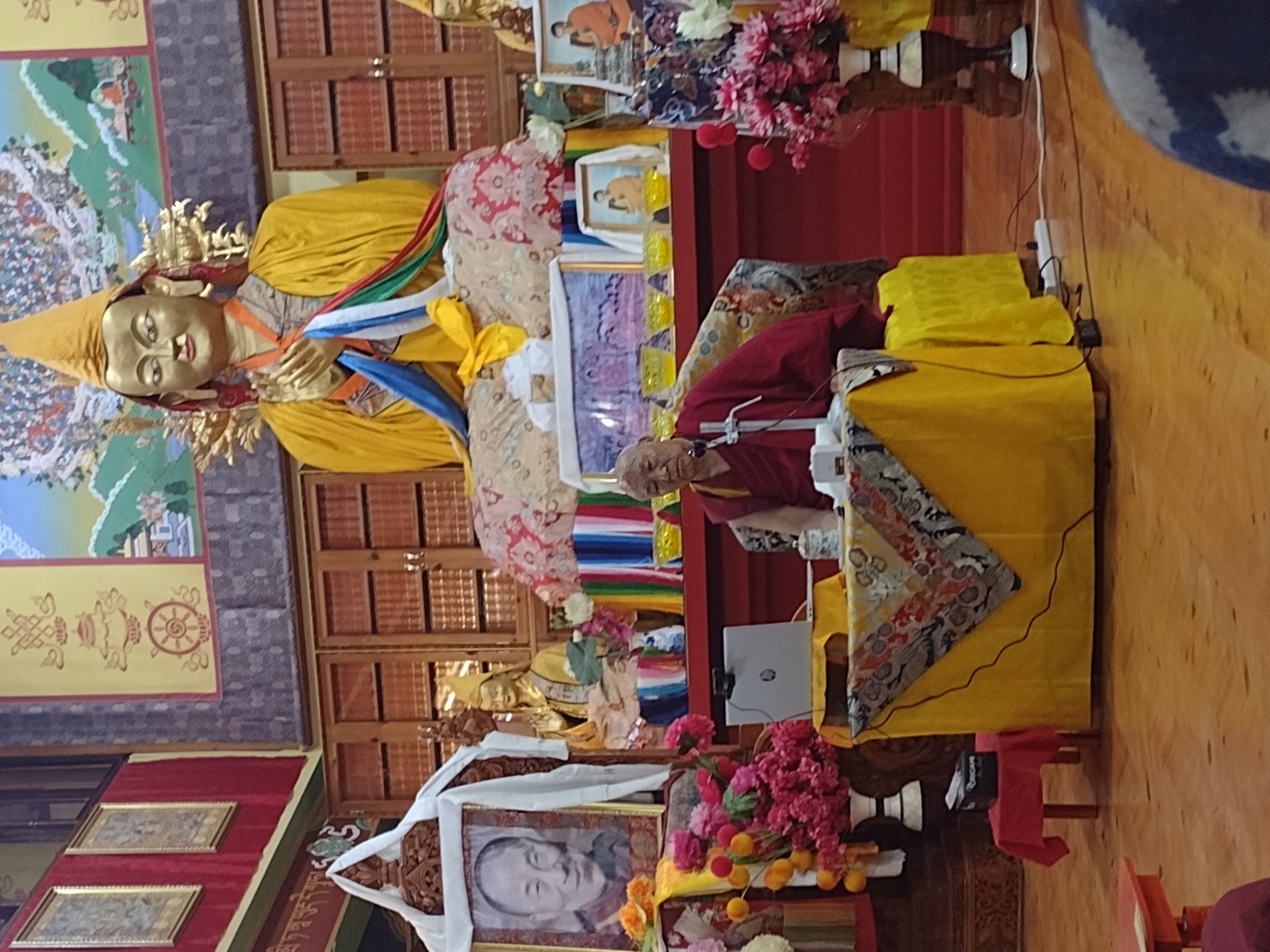
Geshe Lhakdor speaks at the Tushita Meditation Center in DharamkotThe lesson was based on the Prajnanama-mulamadhyamika-karika – an ancient text by the Mahayana philosopher Nagarjuna – and his follower Chandrakirti’s Madhyamika-avatara. The texts focus on the Middle Way, or the Madhyamaka philosophy.

The first day was an actual discourse by the spiritual leader of the Tibetan people in exile while the second day was a question and answer session for the Asian teachers association that sponsored the public teaching. Although the second day was also being translated, I had a terrible time with my FM radio and gave up trying to both listen and take notes.

In addition to the Dalai Lama teaching, I also attended several programs at the Tushita Meditation Center near where I was staying. Among these programs were several guided meditations, a 16-hour weekend meditation workshop and a teaching by Geshe Lhakdor, a former translator for the Dalai Lama and current director of the Library of Tibetan Works and Archives (which I also visited the day I taught English to a group of young monks).

With all those lessons, you might think I could write a book on the subjec; but no, I still had to buy a book in which the Dalai Lama’s 1974 article “The Key to the Madhyamika” is reprinted and I also read some internet articles on the Madhyamaka philosophy.

With all that information in hand, I still don’t really know where to begin.

I understand it; I think. But it is incredibly difficult to put into words what it means.

Emptiness – Sunyata

The core of this epistemilogical teaching is that no object that we can perceive with the six senses, which include the mind as the sense organ for thoughts, has an inherent reality outside the mental concept that the senses assemble.

The way the Dalai Lama explains this terribly difficult concept is by using an example of a rosary or mala. When we dissasemble the rosary, we are left with 108 regular beads, the head bead and some string. None of these things alone constitutes the rosary. So when does it take on the form of a rosary. This is not a quality interent to the beads or the string itself but an idea, a mental construct, that the mind assigns to the beads.

Our meditation workshop instructor also used an example of a pen. He noted that in addition to being used for writing, a pen could also be used for stabbing someone. Would it still be a pen or would it be a shiv?

You can conintue to disassemble things all the way down to the atomic level and ask these same questions. So this is the essence of sunyata.

And it applies not just to malas and pens, but also to people. The self and others – all the thises and thats of our dualistic world.

So just like the pen does not exist without the mind to assign it meaning; neither do I exist nor do you exist. So nothing exists.

That seems pretty nihilistic. But the Tibetan Buddhists don’t want to be nihilists either. And herein lies the dilemma.

My Vow to a Nun

I showed up to the teachings with Benjamin for New Zealand, but he ended up trading spots with a young nun, named Tenzin Drolma, who was sitting behind him. She is a Nepali native, and like the class of monks at the Dechung Monastery I had the honor of visiting, she speaks English quite well. It turns out we have a lot in common.

At age 28, Tenzin would have been born around the time I first started exploring Buddhist and eastern philosophies in 1994. Just like me, she was in college studying journalism and mass communication, when the allure of the materialistic world gave way to her desire to pursue a deeper spiritual knowledge. She took her vow to the Buddhist faith a little more seriously than I did when I was in college, moving to Dharamshala and joining a Buddhist convent. She has had private audiences with the Dalai Lama on several occasions and diligently took notes in Tibetan as he delivered not only his lesson, but the question and answer session as well.

Near the end of the presentation, we had a discussion and she urged me to seek a teacher or guru. To date, my laissez faire nature has said it will happen when it happens, but she encouraged me to try – to devote my efforts and concentration to the task of finding someone who can help me along the spiritual path. I told her I would try. After asking about my future travel plans and learning that I intend to visit Lumbini, she asked that I make a promise. She gave me a few rupees and asked that I remember her and offer a devotion at the site of the Buddha’s birthplace asking for the liberation from suffering of all sentient beings.

I made a vow that day to that little Bodhisattva that I intend to keep. She scurried off into the crowd with her friend and was gone just as quickly as the Green Tara at the pooja of the week prior.

Compassion – Bodhicitta

So instead of swallowing the pill of nothing exists, therefore do whatever we want; the Dalai Lama urges us to do what makes us happy.

In accordance with the Four Noble Truths, expounded by the Shakyamuni Buddha Siddhartha Guatama, the only way to be happy is be rid of suffering.

The Four Noble Truths in a nutshell are: 1) there is suffering in the world; 2) suffering is caused by desire; 3) suffering can be ended by ending desires; and 4) desires can be ended by living a life in accord with the Noble Eightfold Path.

So basically, unless we are extremely well focused on our meditations and are completely able to silence the mind, we will continue to have this stream of sensory input. This is not necessarily bad in itself, but it is the root of suffering. So until we can turn this off, we have to learn to live with it to some degree.

The key to doing this successfully, according to His Holiness, is bodhicitta or the compassion of the Bodhisattva.

Not to brag or anything,” liberally paraphrasing the translator, the Dala Lama said, “ I have some degree of experience with this. In my daily life, I can feel I have a relaxed way. It is not like taking a tranquilizer, but how we take feelings like anger, grief, jealousy, pride, arrogance, and so forth, and deal with them.

“Based on the teachings of the Buddha, when we reflect on Bodhicitta and emptiness, you can see how thoughts arise and you can feel a sense of ease when as this emptiness settles over you.”

Teaching Compassion

He continued on to discuss the plight of the Tibetan people, who have been in exile since 1959, about 10 years after the Chinese Communist government invaded and took control of the Himalayan nation.

While his own escape and life in exile has been a challenge, he siad it has also been “a blessing in disguise” as it has allowed him to spread the teachings of the Buddha far and wide.

The lesson also touched on the importance of spreading mindfulness and compassion as a secular teaching in schools worldwide to help eliminate the negativity that comes with materialistic thinking.

“It is not a religious matter at all,” he said. “If you are loving and compassionate, you will be at ease with yourself. When there is discord among groups, people take up weapons. This has to stop.

“It is through the practice of generosity, such a person would be able to cut through the tensions between beings and enter into a state of peace. Giving to beggars and donating to education, as a result he will journey toward a state of peace. The bodhisattva takes joy in giving at all times.

The bodhisattva sees pain as something undesirable to themselves. They see the pain of others and the pain of beings of the animal realm as undesirable to themselves. This is the moon that shines a light and dispels the darkness,” His Holiness said, quoting from Nagarjuna.

He concluded the initial day of teaching with an introduction to the “Generation of the All Encompassing Yoga Mind Meditation” which he practices multiple times throughout the day.

The technique involves visualizing a white disc at the heart center with a five-pointed vajra and focusing on bohcitta.

“If you think not only of yourself whereas seeing all other sentient beings are the same as yourself, not wanting even the slightest suffering but wanting perfect joy.

“The bodhisattva sees as clearly as a berry on his palm and uses the two wings of conventional and ultimate truth to cross the sea of samsara like the king of swans.”