Submitted by reuben on Fri, 12/16/2022 - 03:24

Sarnath, Kausambi, Allahabad & Sanchi

The final leg of the Buddhist pilgrimage ended up being one of the most spiritually rewarding parts of the journey as I not only read the Buddha’s first teaching in the spot where it was delivered but had the opportunity to practice chanting it in the original Pali, under the guidance of a kindly Theravada monk from Sri Lanka.

Although I was becoming somewhat drained by all the travel, the journey took me east to the ancient city of Varanasi and the nearby town of Sarnath where the newly enlightened Buddha met with the five ascetics who had parted ways with him at Bodh Gaya. It was here, the Buddha delivered the Dhammacakkappavattana Sutta (Setting the Wheel of Dhamma in Motion), to the first five disciples.
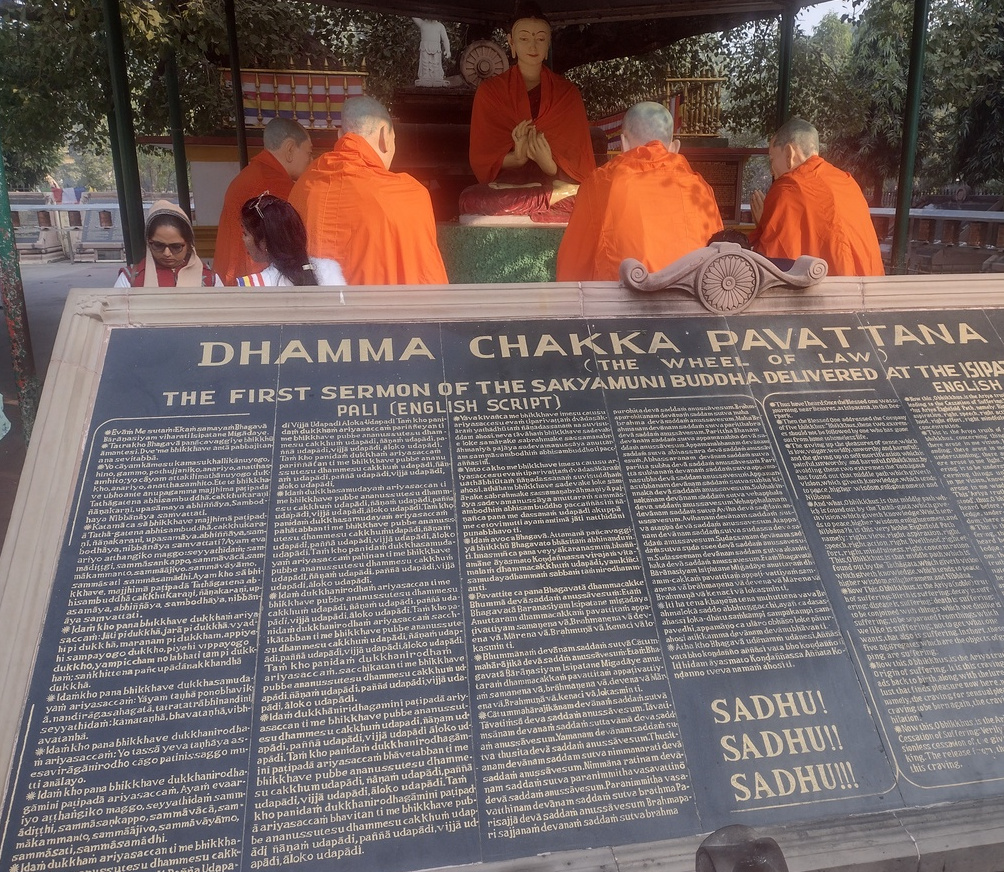
Buddha teaching 5 disciples

The pilgrimage then took me to the very rural town of Kaushambi, an ancient and once prosperous town where the Buddha spent two monsoon seasons. It is now very sparsely populated and somewhat difficult to reach. There is little in the way of lodging there, but the one Sri Lanka monastery there offered not only a bed and meals, but also an opportunity to chant the Dhammacakkappavattana Sutta in Pali with the resident monks.

I wrapped up my tour with visits to the museum at Allahabad and then stopped by the town of Sanchi – a Buddhist site established by Ashoka that was never actually visited by the Buddha himself.

In all the pilgrimage, I think I missed only one site – Sankisa, which was where legend has it, the Buddha returned after ascending to the heavenly realms to preach the Dhamma to his mother Mahadevi, who passed away a week after giving birth to her son in Lumbini.
Sarnath: The First Teaching

After leaving Bodh Gaya, I reached Varanasi and went immediately toward Sarnath where the Buddha spent his time. I spent five days in this area, two nights in a guest house and three in a Tibetan Buddhist monastery, visiting both the historic Buddhist site and the ghats of the Ganga River in old Varanasi that are more popular among western tourists.

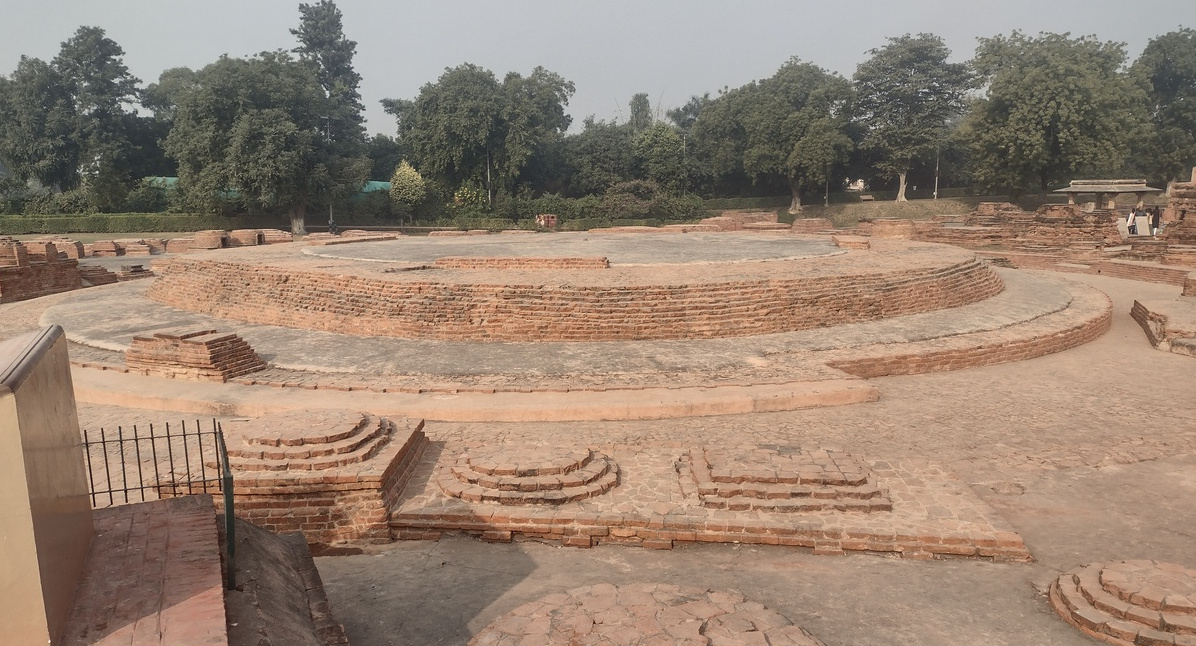
Ruins of the Sarnath relic stupaThe Sarnath site is an impressive collection of excavated archaeological ruins of the Ashoka pillar and monasteries, along with a park called Deer Park, where the first sermon was delivered, and a separate lone stupa called Chaukandi, where the the Buddha first met the five disciples. There is also a very nice museum here, where the very well-preserved capital of the Ashoka pillar featuring four lions facing the four cardinal directions, is on display.

Cost for foreign entry to the sites is 250 rupees each for the archaeological sites and just 5 rupees for the museum. The ticket counters, however, are not staffed and visitors are expected to buy tickets online, which is a problem because no foreign banks are able to access India’s electronic UPI system at the time of this writing. I had to pay an extra 50 rupees to a vendor for entry into the main site and 5 rupees for the museum. I did not go into the Chaukandi site but viewed it from the adjoining Garden of Spiritual Wisdom, which is privately run property but offers a serene stroll through a sculpture garden along with a very nice view of the stupa for just 50 rupees.

Chaundakandi StupaThe iconic Dhamek Stupa, shown in most photos of the Sarnath site, was under restoration while I was there, with workers on scaffolding cleaning and maintaining the surface of the structure. I spent time meditating near the spot where the Buddha was believed to have lived while he was in the area.

Also at Sarnath is a large standing Buddha statue, located on the premises Wat Thai temple and monastery grounds. There is also a World Peace Pagoda, smaller and less busy than the others I have visited, at the Japanese temple. The Chinese temple offers a nice tribute to the explorer Xuanzang – the venerable monk who traveled the pilgrimage path and serves as the inspiration for the beloved Chinese classic Journey to the West.

During this time, I also visited the ghats of Varanasi, where the massive Ganga aartis take place nightly along with around the clock burning of bodies on smoldering funeral pyres. The streets of the old town are very compact, which means no motor traffic other than some motorcycles. The vibe, however, was much like Kathmandu, however, with a large number of hustlers trying to separate tourists and travelers from their cash and many restaurants and bakeries geared toward western tastes.

Getting back and forth to Sarnath from old Varanasi was not particularly easy, but I made the trip twice to explore that area. While it was much less touristy and western, I enjoyed the quiet room I had at the Tibetan monastery much more than the bustle of the busy city.

Kaushambi: Chanting with Monks

Getting to the next stop at Kaushambi proved to be a little challenging as it is off the beaten path and not a place that is regularly visited. I took a train from Varanasi (although I believe now that there is a train that leaves direct from Sarnath) to the city of Prayagraj, aka Allahabad. From there, buses do run to Kaushambi, but they do not leave from the bus stations but are at random places toward the west; the right tuk-tuk driver can help you find where these buses leave.

Once I got on the correct bus, it dropped me right at the intersection of the town where I was able to find lodging in the Sri Lanka monastery, which is just one of a handful of monasteries that are at Kaushambi. The other monasteries are the Cambodian monastery, which was under renovation while I was there, and the the Myanmar / Burmese monastery, which was also under construction.

Sumanasiti and me at the Ashoka pillarMy stay at the Sri Lanka monastery, however, was nothing short of amazing. The chief monk of the monastery, the Ven. Vishuddhi, greeted me and offered me an evening snack before one of the young men who worked at the monastery showed me my room.

I then met the Ven. Bibile Sumanasiti Thero, who invited me to join in the evening chanting of the Dhammacakkappavattana Sutta. This was my first time being able to chant with monks. It was a little difficult to follow along from the internet link I found but I did my best to keep up with the unfamiliar Pali intonations. (link to e-book with original Pali text)

The following evening, we would chant some additional sutras, the Ratana Sutta (The Jewel Discourse) and the Maha Mangala Sutta (Discourse on Blessings) (Additional sutras)

After waking up that morning, the Ven. Sumanasiti drove me around the dusty area in this cool Indian style car, which made me realize that for all the other forms of transportation I had used on the pilgrimage thus far, I had yet to ride in a regular automobile.

We visited the site of the Ashoka pillar, along with the Ghoshitaram Vihara, which is the site of the monastery built by local merchants for the Buddha to stay in during his visits to Kaushambi, the 62-year-old monk explained to me.

We also saw a gate in the excavated walls of the fortress, which once surrounded the Kaushambi city, which was once a major capital of a kingdom along the Yamuna River, along with the remains of King Udayin’s palace along the banks of the river.

There are no entrance fees for any of these sites, but workers were constructing walls around them, which Sumanasiti indicated would probably be the first step in the Archaeological Society of India making the sites pay to enter.

Cambodian Temple at Sarnath

That afternoon, I walked up the way to the nearby Cambodian temple. Despite the fact that the monastery was undergoing a renovation project, the chief monk Tandan greeted me with a cup of Cambodian coffee and gave me a private tour inside the temple, which is adorned with beautiful frescoes depicting the life of the Buddha.

It was a beautiful temple but, like the Sri Lanka temple where I was staying, receives only few visitors in the wake of the coronavirus epidemic that has affected much of the tourist economy for the past three years.

Allahabad Museum and Park

The following morning, I had breakfast with the Ven. Guruji Vishuddhi and caught a bus back to Prayagraj. I was there by mid-day but my train was not scheduled to leave until 11 p.m. This gave me time to stash my luggage in a locker at the train station and explore the area a little.

One of the main features of Prayagraj, formerly known as Allahabad, is the fact that it is the city where the Yamuna River converges with the Ganga at a point called the Triveni Sangam, where the 55-day Kumbh Mela ceremony occurs every sixth and twelfth year, with the next Maha Kumbh Mela slated to occur in early 2025. This site was pretty far from the railway station so I opted to visit the museum at Allahabad Park, which was just over a kilometer walking from the train.

Gandhi quote at Allahabad Museum

The museum, although it cost 600 rupees to enter, did not fail to disappoint. It is, by far, the largest and most extensive museum I have visited in India to date. It took several hours to tour and included, not just archaeological relics, but also historic and modern art; geo-political and local history displays and even a zoological exhibit. Some of the artifacts there dated back thousands of years to the dawn of civilization in the Indus Valley while more modern displays offered history of the important role Allahabad played in India’s liberation from British rule in 19th and 20th centuries.

The park that surrounded this museum was also quite nice, offering a nearly 2-kilometer running and walking track that surrounded some lovely green space in the otherwise bustling part of the city. I spent over an hour walking and talking to locals before making my way back toward the train station, stopping for dinner at a local pizza joint and coffee in an effort to kill some time.

Taj Mahal: Been There, Done That

No first trip to India would really be complete without a stop at the iconic Taj Mahal. So the train I took out of Prayagraj took me onward to the city of Agra, where this icon is located.

I arrived early in the morning and was able to leave my things at Joey’s Hostel, which I had booked in advance as it is only a couple of blocks from the Taj Mahal itself.

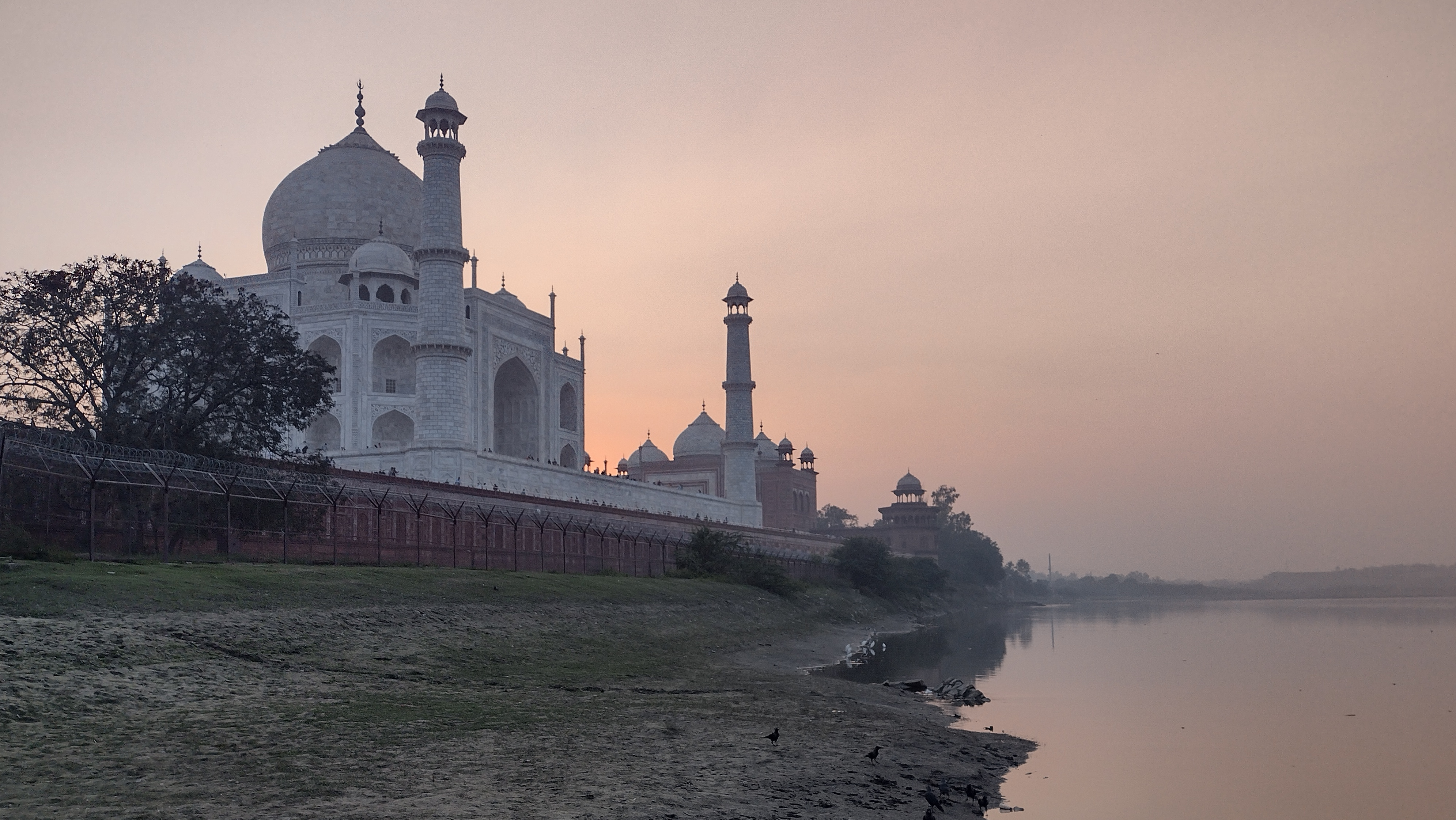
Taj Mahal at Sunset

Before touring the site, which costs 1,300 rupees to visit, I made my way through the nearby nature park shortly after sunrise. The park is quite nice, especially at that time of day when the birds are quite active and the tourists are not. There were plenty of beautiful peacocks, parrots and other avian species, along with chipmunks and small critters taking their morning meals throughout the gardens. As I mentioned, most tourists who were active that time of day were probably still at the palace so I virtually had the place to myself. It proved to be a lovely spot for a morning meditation and a few thousand steps toward my daily goal.

Later that day, I did make my way onto the proper Taj Mahal grounds, admiring the exquisite work of marble and semi-precious stones that I calculated would have cost approximately$1.7 billion USD to build in today’s currency. Of course, that does not really factor in labor costs, which would probably drive the cost of construction much higher than this figure by today’s standards.

I had mixed emotions about the Taj Mahal itself. Some people call it a testament to true love, but I don’t know if I really buy that. Sure, the Moghul emperor Sha Jahan must have been extremely smitten by the Persian noble girl Arjumand Banu, aka Mumtaz Mahal, but she was certainly not the shah’s only wife and not even his first. She died after 18 years of marriage after giving birth to their 14th child together. Shah Jahan had this elaborate mausoleum built for his wife, but it just struck me more as a testament to vanity and egoistic self-indulgence than anything really romantic in nature. I don’t know, maybe that is the cynic in me speaking, but I just didn’t get that warm and fuzzy vibe from it.

Regardless, it is a pretty spectacular feat of modern architecture that warrants its status as one of the Seven Wonders of the Modern World.

The next day, I would catch an early train out of Agra, bound for the final stop on my Buddhist pilgrimage.

Sanchi – not Sankisa

So the final stop I visited on the pilgrimage was Sanchi. I think when I planned this, that I thought this was the same place as Sankisa, which is not true. Sankisa is the place visited by the Buddha on his mythical return trip from the heavens while Sanchi is a Buddhist monastery site set up by Emperor Ashoka on his journeys through the kingdom building stupas and pillars to honor the Buddha.

If I had visited Sankisa, the proper way to get there would have been to get off at a stop between Prayagraj and Agra and take a bus north from there to the Sankisa site, which I hears is somewhere larger and more visited than Kaushambi, but not as popular as Vaishali.

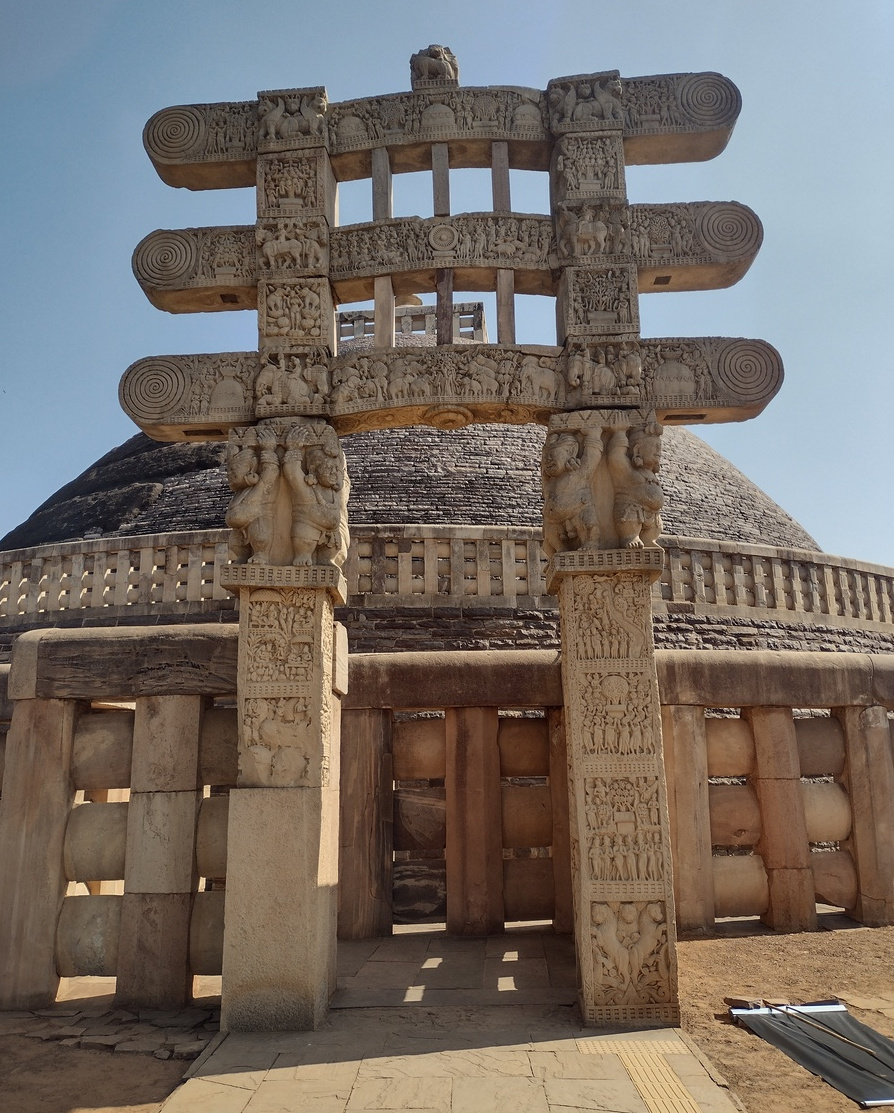
Main Stupa and Gate at SanchiRegardless, Sanchi was nice and fairly easy to access. I got off the train at Bhopal and was able to immediately hop on a local train onward to Sanchi. It only took about 45 minutes and I had arrived before sunset.

I took a room at the Mahabodhi Society Pilgrim’s Rest Guest House on the grounds of the Sri Lanka temple, which I was disappointed to learn was more of a upscale hotel and wedding venue than a monastery setting like I experienced in Kaushambi.

I also came down with another bout of stomach illness, probably from something I ate or drank and this bout ended up being quite fierce for about three or four days. I woke up feeling OK, but I could tell I was starting to feel kind of sick. It would get worse as the day wore on, however.

I did have enough energy to get up and walk to the site of the stupa and surrounding monasteries, which costs 600 rupees for a foreign ticket. It is an impressive site with large ornate gates situated at all four cardinal directions around the main stupa. I toured the grounds, which are spread over several acres, but started to get tired near the end.

After a rest near the gate, I walked back down from the site and visited the museum, which is just 5 rupees to enter. I had very little energy left to enjoy the museum properly. I was stopping to rest in each of the four or five galleries. I spent very little time inside and ended up taking a nap in the sun on a bench outside the museum.

I spent the remainder of that day in my room resting and fighting a fever.

An Auspicious Day

Although I was still feeling sick, my final morning in Sanchi – my final day of the Buddhist pilgrimage – was an auspicious day as it was not only a full moon, but the first full moon of the month of December. The moon was technically full at 9:30 a.m. India’s time that final morning as I made my way out into the world for the day.

Dec.8 is celebrated by Japanese Buddhists, and maybe some others as well, as the Bodhi Day, commemorating the day the Buddha achieved enlightenment. Most other Buddhists celebrate all the important days of the Buddha’s life on the same day, Vaishakh Purnima, celebrated on the full moon in May.

I’m not sure who is right as that has been some 2,600 years ago, but regardless, it seemed to be the perfect day to end this segment of my India adventure and head onward to south India, where I plan to focus on my yogic studies again.

While the lessons of this phase of my journey are still weaving themselves into the fabric of my being, one thing I think I can say after this is that I have learned better who I am. In the past, when people ask what my religion is, I have hesitantly answered that I am “mostly Buddhist,” without even really understanding fully what I meant.

Today, I understand and have experienced Buddhism not only as a religion but as a philosophical daily practice. I not only have a deeper understanding of the Buddha’s core teachings, but I have seen firsthand how followers from all parts of Asia practice and pay homage to their lord and great savior.

I have seen the vast diversity among the practices firsthand and have had a chance to participate in a many different rituals and meditations. I won’t say that I philosophically agree with everything I have experienced or that I intend to incorporate every practice into my new way of life, but I am certainly richer for the experience.

And the riches this pilgrimage have bestowed on me are ones that will pay dividends not only in this lifetime but for many more to come.