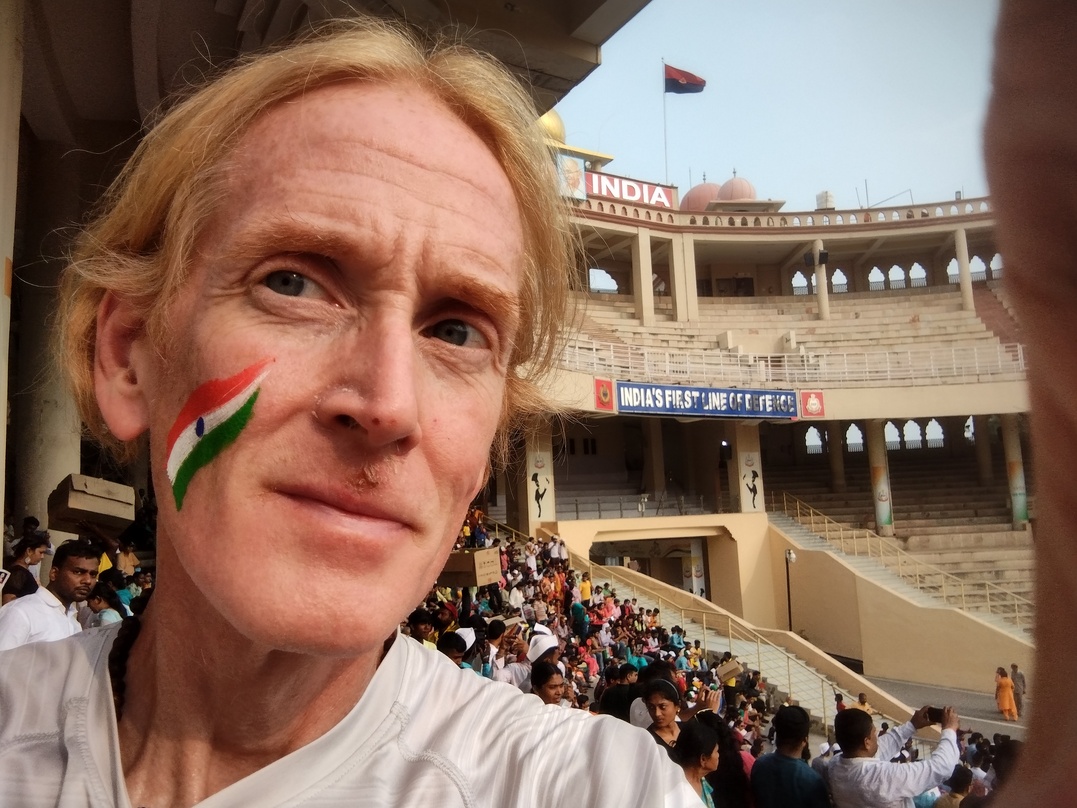
 Despite the chaotic ride to get there, we did make it to the Attari-Wagah changing of the guard ceremony safely without any incidents. We stopped at one point for side of the road food and I paid a guy with a paintbrush 10 rupees to paint an Indian flag on my face. It was kind of cool the way they did it in three quick brush strokes with a dab of blue in the middle.
Once we arrived, some people pointed me toward a special section for foreigners attending the ceremony. It was basically right up against the border.
So the event started with what felt more like a street party than a formal military ceremony. One of the Border Security Forces troops was in the middle of the road inciting the crowd to cheer and chant and then a group of Indian women made laps on the road waving Indian flags as they ran. This was followed by about a half hour of women dancing in the road to patriotic pop music.
I was sitting next to a young man who had just arrived earlier in the day from South Korea and asked him if he could imagine anything like this at the border with their neighbor to the north. He chuckled at the thought of the DMZ being the site of a party.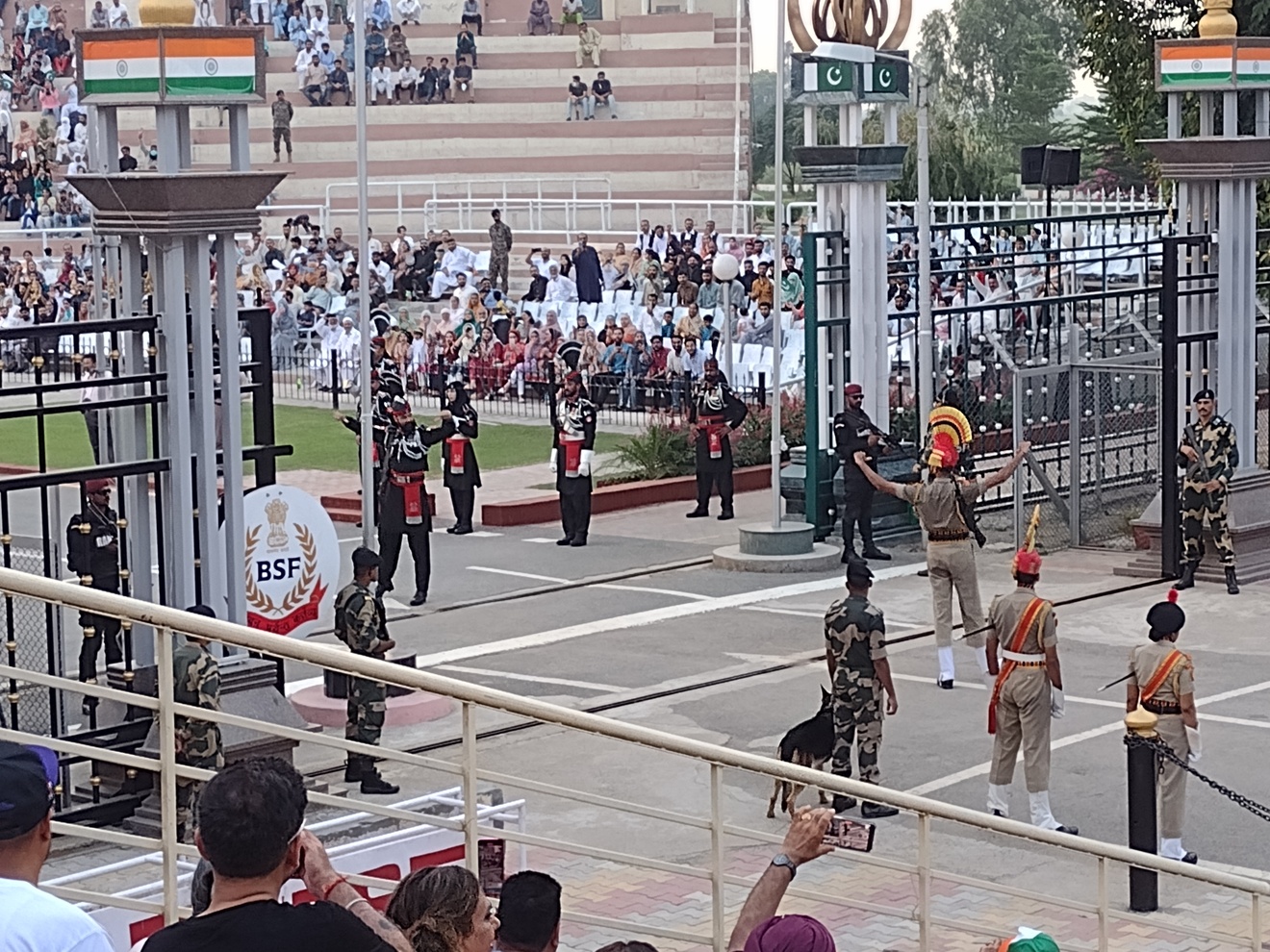
Eventually, the formal part of the changing of the guard started. The ceremony, which was mirrored on the Patkistani side of the border involved opening the gates between the two countries. Then members of the guard marched with high kicks and waving of the arms towards one another and greeted each other at the demarcation line.
It was, as far as I could tell, a display of both competitiveness and cooperation between the two countries quite unlike anything I expected going into the event. The whole thing concluded with a lowering of the respective national flags and a closing of the gates.
It was definitely entertaining and pretty much free other than the tuk-tuk ride there and the avoidable 150 rupee charge for stowing a bag in a locker as bags and many other items are prohibited at the event.